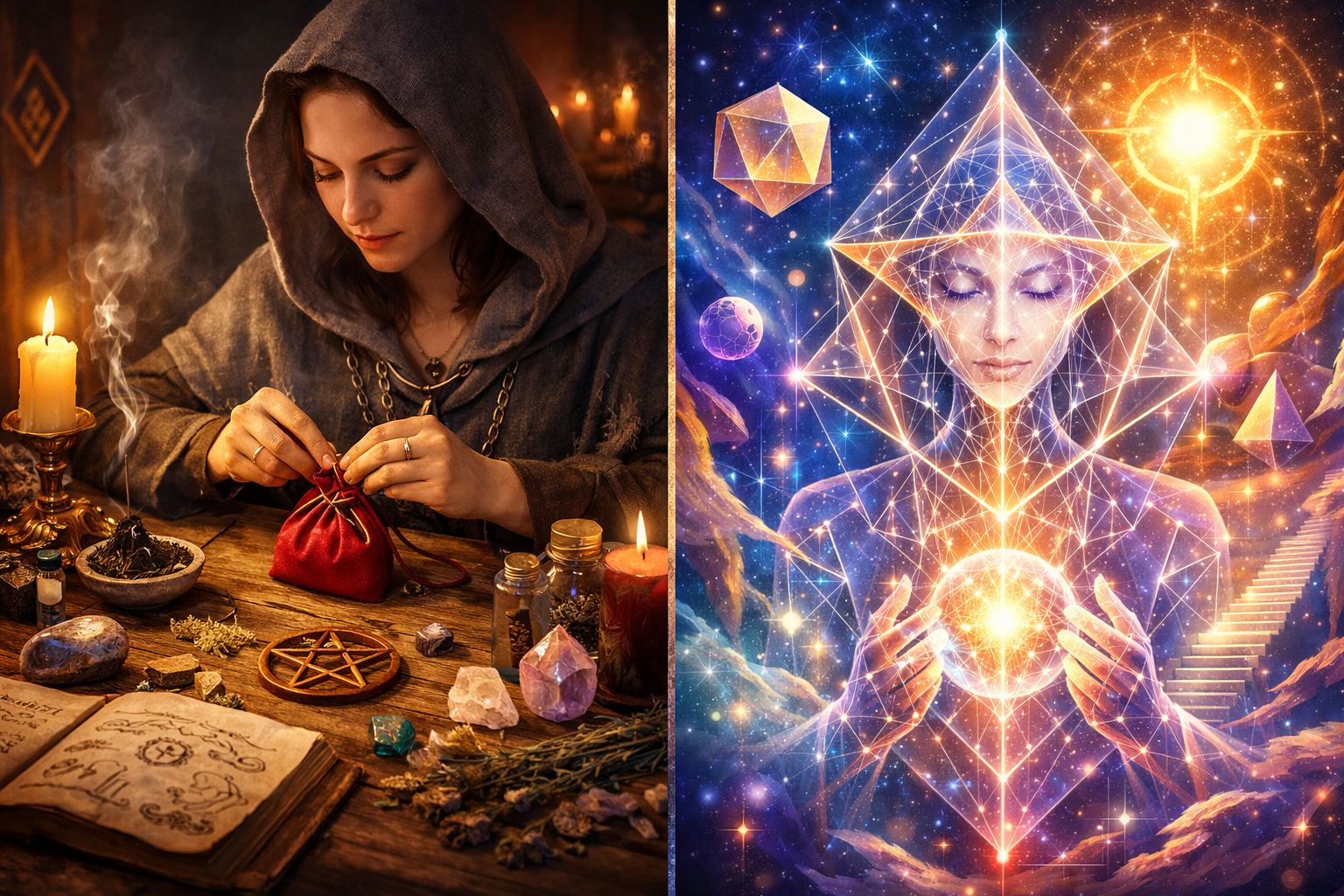
There are many forms and kinds of magic but only two major branches, or divisions of purpose. The two branches designate the underlying purpose of the work – not the reason it is being done or what it seeks to accomplish, but why it exists and is practiced in the first place.
Practical Magic
This is your everyday, problem-solving, magic of getting things done. You use it to find your keys, heal your dog, receive new money, learn a secret, or repel a nuisance visitor.
Practical magic can be performed in either a fancy or straightforward manner, a ritual in a circle or a minute of stuffing gems and herbs into a bag. What makes it practical isn’t the procedure, but the intent.
If it affects life, whether day-to-day or as a whole, it is likely practical magic you are practicing. Most of this work aims to solve a problem of some sort.
Esoteric Magic
Often called magic for the sake of magic, esoteric work makes great training material to build skill and experience. While this magic may contribute to the solving of problems or achieving a real world end, such effects are usually indirect.
The primary aim of esoteric magic deals with spiritual or metaphysical matters beyond the scope of daily, mundane concerns. Examples include astral journeying, communicating with spirits (outside of doing so to solve a specific worldly problem), divinations of a broad nature (looking generally at the future or asking “what do I need to know”) and other operations designed for the primary purpose of generating a magical effect or experience.
Admittedly the line between the two branches can, at times, get a tad fuzzy. In general, the more a magical operation resembles mysticism, the more likely it is to be esoteric in nature.
different kinds of magic?
According to anyone with an opinion, magic can be broken down and subdivided into a painful array of distinct kinds, types, sorts, and categories. At one time I had a whole tree of magical classification to demonstrate my dorkiness to all comers.
It’s just not needed. The pain and worry of the endeavor much outweighs the pretend benefits of the work.
While an exhaustive, all-encompassing diagram is superfluous, a couple more headings beyond “Branch” could be useful.
Class of Magic
This heading actually has utility because it distinguishes what is involved in the learning and execution of any magic. The two classes are “High” and “Low” and they have nothing to do with morality or good vs. evil.
High Magic
High magic is often but not always ritualistic and/or ceremonial. It involves often complicated procedures like calling a spirit through a full hierarchy of beings or building a symbol through other, prerequisite symbols during an operation.
It may require the use and understanding of one or more specific languages or call for particular textual material. In the medieval Grimoire period high magical literature demanded a full room consecrated and dedicated solely to magical study and practice.
That’s a tall order for some people today. During the Middle Ages only nobility, clergy, and merchant class could afford to surrender a whole room solely for magical use.
High magic is, in a very real sense, aristocratic magic. It is the Gucci or Ferrari of the arcane arts.
It costs more because it requires highly specific and at times difficult to obtain or expensive ingredients and components, including specific ritual attire and elaborate props.
High magic is sometimes concerned with the pedigree or lineage of a practitioner. It involves active initiatory procedures and might even require membership to a particular lodge or access to a specific teacher.
The magical methods and techniques are also typically more complicated and more difficult to learn that those of lower magical work. The use of wands and other tools, multi-step acts, and precise timing of operation are all marks of high magical work. If we’re being blunt, and I try to be, high magic also offers a magician access to a loftier range of goals, and can understandably generate greater power towards achieving one’s aims.
There are exceptions, like epic natural talent or other unusual circumstances. In most cases, however, high magic simply offers higher returns than low magic.
After all, as the first axiom of magic tells us: Input equals output, or the effort applied determines the rewards received.
Low Magic
If high magic is Gucci, low magic Carharrt. High magic being the equivalent of Ferrari, low magic corresponds to Ford.
Carharrt is great. It stands the test of rugged work over time.
I love Ford trucks. I’ve owned three; two rangers and an F-250.
There’s nothing wrong with, nothing weak or shabby about low magic. You can kick some serious ass and do some amazing things with the straightforward, uncomplicated, accessible arcane methods of this class.
Low magic usually calls for everyday ingredients that are already in many homes. While timing can be important, often low magic can be performed at the drop of a hat any time of the day, week, or month.
Low magic can involve rituals and magic circles but typically lacks the complex operations and layered workflows of high magic.
This class of magic doesn’t require learning any languages or even involve formal initiations in most cases. It is the magic of the everyday individual.
As you can see, it’s fair to say the class of magic is a good indicator of the complexity, preparatory work, and financial cost involved.
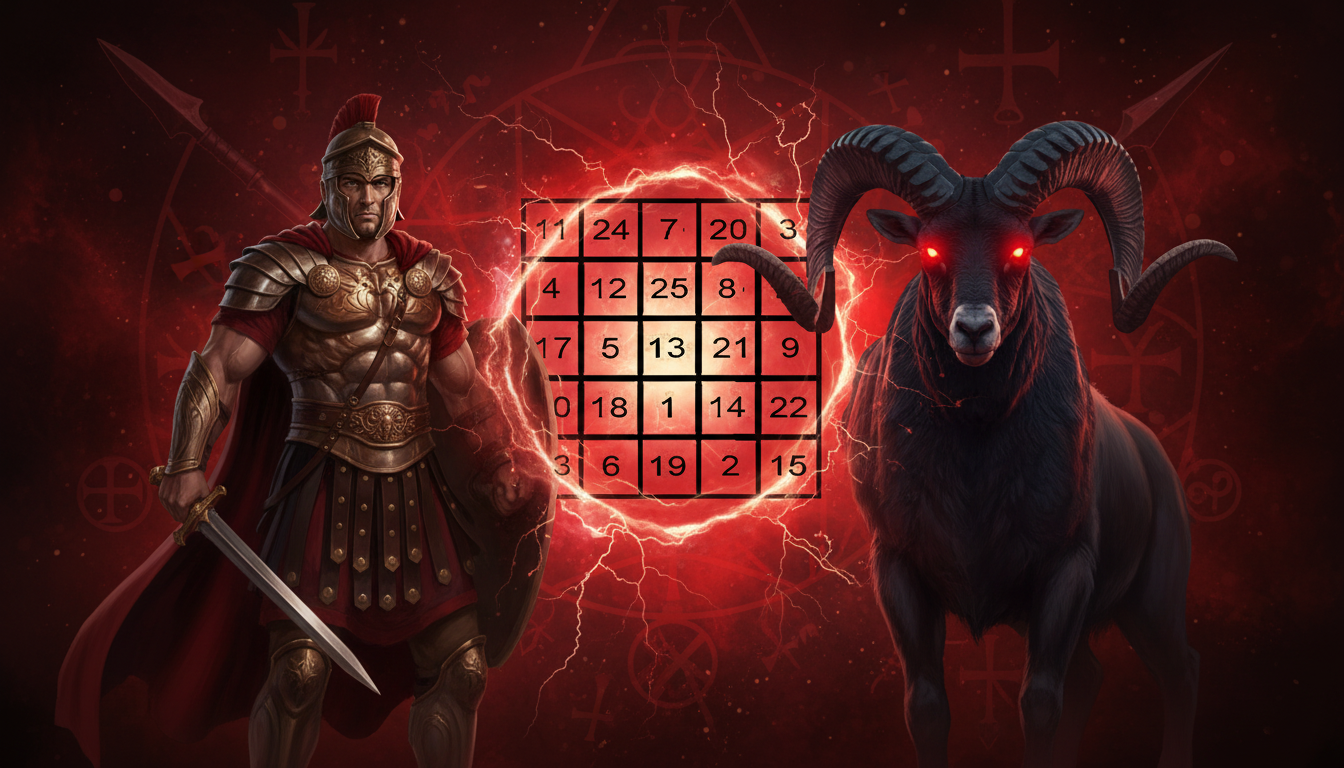
There are moments in working with a Kamea when the numbers stop behaving like arithmetic and begin behaving like a language. The Square of Mars does this more readily than most. Its diagonals, in particular, speak with a kind of structural poetry — a pair of mirrored currents crossing through the heart of the square like two blades meeting at a single point.
Hidden Numerology & Energetic Scaffolding of the Mars Kamea
Take the diagonals 3, 8, 13, 18, 23 and 11, 12, 13, 14, 15. Before we consider the center, remove the 13 from each line. What remains is a revelation of structure:
The outermost numbers sum to 26.
The inner numbers also sum to 26.
This happens on both diagonals. Two pairs per diagonal. Four pairs total. All resolving to 26 — the sum of the first and last numbers of the square, the breadth of the Martian current, the arc from initiation to completion.
This is the square showing you its full span. This is the cycle of beginning and ending, force and fulfillment, encoded twice over.
Multiply that base of 26 by the order number of the square (5) and you arrive at 130, the sum of two rows — the doubled backbone of the Kamea. When both diagonals encode 26 twice, and both diagonals cross through 13, these lines reveal themselves as the structural brace of the square, the two supports that hold the Martian edifice upright.
The Power at the Center of the Magic Square for Mars
Removing the 13 for a moment is appropriate, because it belongs to both diagonals equally. It is the crossroads, not the road. Yet 13 refuses to vanish. It is half of 26. It is the physical center of the square. It is the sequential center of 1 through 25, with twelve numbers on either side. Reduced, it becomes 4, the number of foundation and solidity. Multiply 13 by the order number and you get 65, the magic constant. Multiply it by 25 and you get 325, the total sum of the Kamea.
Thirteen is not merely the center — it is the keystone. It is the hinge on which the entire square turns.
When we restore the 13 to each diagonal, the pattern deepens. One diagonal is a perfect sequence: 11, 12, 13, 14, 15 — a rising spine of integers, a ladder of cohesion. The other diagonal moves in steps of five: 3, 8, 13, 18, 23 — the pulse of Mars, the rhythm of the square’s order number echoing through each step.
Basic Numerology and Planetary Magic of Mars
Reducing these numbers to their Pythagorean roots reveals the deeper symmetry:
Right diagonal: 3, 8, (13→4), (18→9), (23→5) Left diagonal: (11→2), (12→3), (13→4), (14→5), (15→6)
Remove the center again and add the pairs:
Right diagonal: 3+8 = 11, and 9+5 = 14 → 5
Left diagonal: 2+3 = 5, and 5+6 = 11
Each diagonal produces a 5 and an 11. But they appear in opposite order:
Right diagonal: 11 – 13 – 5
Left diagonal: 5 – 13 – 11
A perfect mirror. A left–right inversion. Two currents crossing through the same center, each carrying the same energies but in reversed sequence.
This is not numerology as decoration — this is numerology as structural revelation.
The magical constant of the square, 65, reduces to 11. The two 5s reduce to 1, the Alpha, the First, the Dominant. The two 11s reduce to 2, and together they form 4, the root of the central 13. Combine the root of the 5s (1) with the root of the 11s (4), and you return to 5, the order number of the square.
The diagonals reproduce the entire architecture of the Kamea: 1, 4, 5, 11, all orbiting the central 13.
This is resonance. This is coherence. This is the square revealing its internal skeleton.
And this mirrored brace of 5 and 11 crossing through the 13 is not limited to any single operation. It is a universal structural key within the Square of Mars — a pattern that can be used in the construction of servitors, the crafting of talismans, the shaping of sigils, or any working that seeks to anchor itself in the disciplined, forceful, and integrative current of Mars.
It is the square showing you how it holds itself together. What you build from that understanding is entirely up to the operation you choose to perform.
Use the Square of Mars To Build the Red Hammer Servitor
A magical operation—sometimes called a “magical working”—is a comprehensive, goal‑oriented process of magical activity. It is an undertaking directed toward achieving a particular result, executed in its entirety from initiation to completion.
It is more than a magical technique, may be informed by or feed into a magical method, and typically functions as part of a larger magical system. None of this terminology is perfect, nor is it universally recognized among practitioners.
components of a Magical Operation: Breaking down spell mechanics
To build anything it helps you to know what the thing being built is made of. The components of a magical operation are magical acts and techniques.
Magical techniques are built upon fundamental movements and intentions. The foundation for these nuts and bolts is desire, intuition, and purpose; the structure is added by basic knowledge.
It Begins with the Paradigm
When you begin to study and practice magic, typically your first steps are reading a few pages or watching a video to get oriented. This gives you a general idea of the paradigm – or model – maybe a definition or two, and a direction to move in.
This initial exposure and ongoing learning give you the knowledge to dress the desire and purpose you probably had before you picked up your first magical book. Your intuition, which led you to the book you chose over the other options, helps you make sense of the sometimes-strange new things you are learning.
You don’t need to memorize this. It’s included for the sake of thoroughness.
foundational spellcraft: Fundamental Intentions and Movements of magic
These are the nuts and bolts that make techniques.
Fundamental Intentions
Examples of fundamental intentions include positive expectation, or setting your mind to anticipate the desired outcome and holding that. Emotional generation is another good example, wherein you deliberately produce an emotion like joy, fulfillment, anger, or any other emotive condition and sustain it.
Intentions shape the internal conditions techniques rely on.
Fundamental Movements
Magic is by no means constrained to the mind and emotions. Nor is the body’s participation limited to the processing of feeling states and verbal components.
Magical work often involves physical effort and activity. Obviously, there are tasks like drawing symbols and lighting candles. There are also special techniques like using a wand or crystal point to direct magical currents or using your hands and posture to channel and project energy, perhaps while holding a mineral to harness and move the energy.
Movements elevate intentions and seal them into the work.
When building your operations you can of course draw from existing techniques or movements, like the ones found in this book. You may find that you want to revise existing techniques or just come up with your own from scratch.
A valid fundamental intention or movement will naturally feed into a technique. Any potential intent or motion you wish to build from should do one of the following:
An intention should be progressive and/or directional, either pointed to an outcome or setting up a movement, or both.
A movement should involve more than physical motion, and should transfer or direct thought, emotion, subtle energy, or magical forces.
Be sure any foundational thought or motion you plan to use for building a technique satisfy the above criteria.
Magical Techniques
Afte the fundamental pieces, the base building blocks of magic are the techniques. Look at how the examples from the previous section form a chain of intentions that build a technique.
You focus the mind on the desired outcome.
Next you choose to make this an expectation or foregone conclusion.
You then create the emotions of satisfaction and elation.
You hold these states in the body and dwell upon or even within them to charge your expectation with power.
A couple of things happen naturally from there. First of all, sustained emotions impregnate the body and become feelings, a more potent expression of emotive qualities. Second, the culminated feelings led by the initial expectation are transferred into projected intention underpinned by affirmative expectation, which is the most basic form of magical will.
Together these steps make the techniques of noetic adoption and affective induction. Noetic adoption occurs after step two and is defined as deliberately taking on a premise with the intent of treating it as real, i.e. to believe it. Once the emotions are engaged and become sustained feelings you are executing the technique of affective induction.
You don’t need to memorize these terms. It’s enough to identify the specific technique, then practice and improve it.
Let’s sequence some physical movements along with basic intentions to build another magical technique.
You could trace the pattern of the pentagram of fire in the air with a wand or crystal point while focusing on the energy of the fire element. This combines movement and intention into a complete technique for connecting to elemental fire.
A magical technique represents a full step from point A to point B. The completion of a technique represents a micro process that accomplishes a magical task or creates a magical effect.
In the example of the pentagram of fire, the magical technique completes the task of drawing the conjuring or invoking pyramid. The created effect is the quality of elemental fire emerging in the environment or responding to your contact from a subtle plane of reality.
The tasks and effects generated through magical techniques are often progressive grades moving towards a desired end result. On the occasion that a technique also creates part or all of the magician’s desired end result, the technique serves as a magical act or operation.
When evaluating a technique you are considering or formulating a technique of your own, ask if the sequence of intentions and movements produce a magical effect or fulfill a specific magical task.
Magical Acts
Magical techniques are combined and sequenced to form magical acts. An act is a single, short process with a definite objective.
This differs from a technique, which completes a task or generates an effect. A task is a component of work, which in turn is activity towards an objective, and an effect is an event or state that contributes to an objective. An objective is a higher order of resolution than either a task or an effect and is one step towards attaining a magical desire or completing a magical goal.
Consider the previously mentioned technique of using the pentagram to contact the fire element, which can be drawn in two ways. Both manners of drawing connect to elemental fire, but one carries the intent to call it forth while the other contains the desire to expel it.
Building a Magical Act with Techniques
For example purposes assume the intention is to conjure fire and use its energy.
Trace the pentagram in the air with a crystal point, beginning from the topmost point and making the first line down to the lower right point (attributed to elemental fire). As you make the line send vital energy or life force down your arm and into the crystal, then send it through the crystal into the line it traces. To send vital force simply intend to do so and push your intentions to make a line of energy along the path described. See a line of red or orange light form where the point traces. Complete the pentagram by making the next four lines while opening your solar plexus chakra and focusing on the fire element. When done, visualize the pentagram of light in the air in front of you.
This is one technique. Now let’s add a couple more to form an act.
Draw an equilateral triangle (standard, all sides equal length) in the middle of the pentagram. See the triangle appear in lines of flame as you trace it. Shift from focusing on fire to assuming a connection – do this by creating the felt-sense of belief that you are communicating with elemental fire; transfer the felt-sense into your solar plexus.
Then raise the intensity of the fire energy with your intention. Put some emotion into it. Liken this to playing a song with a musical instrument and adding feeling to every note struck.
While clearly seeing the red pentagram with the fiery triangle in the middle before you, pierce the center of the triangle, which is in the center of the pentagram by thrusting your crystal point through it. Understand this configuration represents the quality of fire as a subtle energy raising into your body and aura. As your crystal passes through the center of the image say “Ignus Ortus!” (fire rise) and feel the energy of fire radiate from your center through your entire body and out into your aura to form a blazing egg about you. Let the pentagram, triangle, and flames around you vanish from sight, but know the energy conjured remains.
This is a complete magical act with the purpose of invoking, or bringing into the magician, elemental fire. It is performed through three techniques.
The three techniques used were:
Tracing the pentagram of fire to make contact with the element.
Tracing the triangle of fire to establish command.
Piercing the triangle and star to call the fire into yourself.
You can clearly see the various intentions and movements that make the techniques. To draw the pentagram required projecting vital force impregnated with intention, making a deliberate stroke with the crystal point, seeing the line of light form as you traced it, and holding the intention to connect with the fire element. This sequence was combined for all five lines of the pentagram drawing technique.
Each full technique is composed of multiple fundamental intentions and movements.
Intentions and Movements > Techniques > Act > Objective.
The objective for the full pentagram of fire act is to usually to bring the energy of elemental fire into the aura and body of the magician; it can be modified to bring the fire energy into the immediate environment but not into the acting magician.
Be sure any magical acts you create or adopt accomplish a magical objective.
Magical Operations
The magical operation is the crown atop the magical hierarchy of work. It is the main working part or method within a methodology, or framework of operation. As such, an operation is the building block of a magical system.
Relevant magical operations are deployed through specific magical methodologies. Methodologies are strategies executed within a magical system.
You don’t need to memorize the relationship of operations to methodologies and the latter’s role inside a magical system. This information is relayed solely to orient you to the larger schema involved with magical practice. If you advance to the point where these things matter, you will have been exposed to the concepts beforehand.
The purpose of a magical operation is to fulfill a magical desire or achieve a magical goal.
A magical desire is something you want for yourself or someone else in the context of your life. More money, better health, a new doo-dad, the answer to a question, the right opportunity, victory over an adversary, are all examples of events or circumstances you might desire and fulfill through magic.
A magical goal is a complete outcome, but in the context of magical work or esoteric and spiritual development. This could be as lofty as contacting an ancestor or travelling to the astral plane or it could be as simple as banishing energetic debris, ill thought forms, and unwanted spirits from your persona and/or environment.
Returning to the magical act of the fire pentagram, let’s say your goal is to infuse yourself with all four elemental energies prior to a ritual or meditation. In this case you would perform three more invoking pentagrams using the elements of water, air, and earth.
The four magical acts of drawing and piercing the elemental pentagrams would be done in a particular order. You might face the compass direction that corresponds to each element while enacting each pentagram. This would constitute the operations of invoking all four elements.
If your goal was simply to invoke the fire element and then proceed with a ritual – the next magical operation within a larger operational schema – then the pentagram of fire act would serve the purpose of magical operation. A magical act fills the role of magical operation when it completes a magical goal or fulfills a magical desire.
Your magical operations should be aimed at fulfilling a desire in the real world or achieving a goal within magical work.
An Imperfect Language
The metaphysical grammar of this structure is solid and tight, but the everyday language we use to describe it is less than perfect. These guidelines should not be treated as rules or dogma.
While the workflow holds up under most circumstances, there are contexts where the distinctions between components naturally blur. Ultimately, what defines a movement, technique, act, or operation is determined by how the practitioner applies it.
A single magical act can function as a complete operation if it fulfills the magician’s intended purpose, i.r. fulfills a desire or accomplishes a goal.
A technique can stand alone as a magical act if it completes an objective. It is only a technique when its result leaves further work to be done by completing a task or creating an effect that contributes to but does not finish an objective.
Even a fundamental intention or fundamental movement can serve as a magical act if it accomplishes the same functional need of completing an objective. In that role—as an act—these smallest units of magical effort can constitute a full operation when they finish operational work by fulfilling a complete desire or achieving a magical goal.
Breakdown of resolution terminology for magical work
The following unpacking restates and defines the terms used in this article to refer to different endpoints in magical work. This is not standard canon across magical literature, though it or something like it should be.
outcome – general term encompassing any points of resolution
directional – in this context, moving forward or towards the next outcome level
task – small action-resolution, outcome of technique and one phase of an act
magical effect – one step towards or unit of creation, change, or preservation
magical objective – resolution or endpoint within magical working, end of one phase or step within greater session of work
magical goal – the endpoint or fulfillment of magic within the context of magical work; for esoteric magic can be the final resolution; in practical magic the completion of one part of the work being done towards the magical desire
magical desire – the ultimate purpose of the magical working, i.e. what the user wants to have, do, be, or see happen in the world or within the self
I will always use the words above as defined here to maintain consistent dialog across channels. The utter lack of uniform, coherent language across magical instruction in content is appalling; basically what uniformity exists is tied to terms and definitions from the 19th century with a handful of 20th centuries catch-ons. Maybe together we can set some new standards along these lines.
Hierarchy of Magical Work and Aligned Targets
The table below shows how each working part relates to a specific outcome.
Fundamental Movement or Intention
Directional, moving towards outcome or setting up next movement; transfer energy.